Affiliate disclosure: TheTechVector earns a commission if you sign up via links on this page, at no extra cost to you. Our recommendations are based on independent research — we are not paid to favour any provider. Learn more about how we make money.
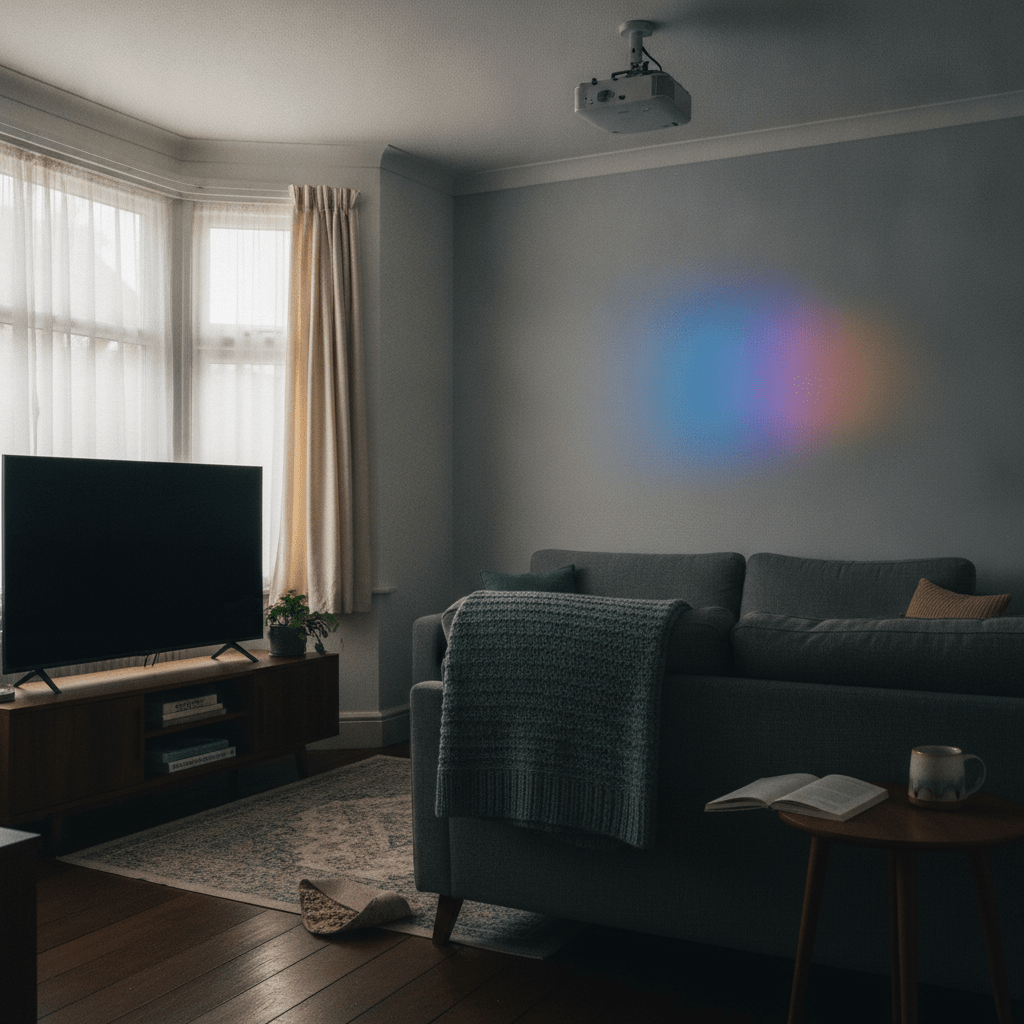
TV vs projector is the wrong fight if you’re picturing a Californian dedicated cinema room with blackout blinds already fitted — most of us are deciding this for an ordinary British living room that has to work at 3pm on a Tuesday with the curtains open. A TV wins on convenience and daylight picture quality; a projector wins on screen size for your money and can turn a plain wall into a 100-inch cinema once the sun goes down. This guide compares them for UK homes specifically — UK ceiling heights, UK room sizes, UK daylight, and the running costs nobody puts in the spec sheet — so you can work out which one suits the room you’ve actually got, not the one a US buying guide assumes you have.
Last updated: August 2026
TV vs Projector UK: The Quick Verdict
A TV is the better choice for most UK homes because British living rooms are rarely dark enough, often enough, to make a projector worth the faff. If your room gets decent daylight and you want something that works the moment you switch it on — sport on a Saturday afternoon, kids’ TV after school — buy a TV. If you’ve got a room you can dim properly (a converted spare bedroom, a garage conversion, a lounge with proper blackout curtains) and want a genuinely huge picture without TV-panel prices, a projector is worth serious consideration.
| Factor | TV | Projector |
|---|---|---|
| Daylight/bright room use | Works fine | Poor unless 3,000+ ANSI lumens |
| Setup effort | Plug in and go | Positioning, focus, often a screen |
| Built-in sound | Usually adequate for casual viewing | Almost always needs a soundbar |
| Screen size for the money | Expensive past ~75 inches | 100 inches+ is comparatively affordable |
| Typical UK entry price | ~£350+ for a 55-inch 4K set | ~£130–£390 for a budget 1080p/4K-capable model |
| Running costs | Just electricity — no consumables | Electricity plus eventual bulb/laser considerations |
| Best UK room type | Any living room with normal daylight | Rooms you can dim — spare room, converted garage, blackout-curtained lounge |
Quick Verdict: Best TV and Best Projector Picks
Winner — Everyday UK Living Room
A 55–65-inch 4K TV. It handles daylight, sounds acceptable without a separate speaker, and switches on instantly. Read our best OLED TVs UK guide for specific picks.
Winner — Dimmable Room, Big-Screen Fans
An ultra short throw (UST) projector. It sits on a low unit against the wall, throws a huge picture, and avoids the ceiling-mount hassle standard-throw models bring in a typical UK room.
Picture Quality: Why TVs Still Win Outside a Dark Room
A modern 4K TV wins on picture quality the moment there’s any light in the room, full stop. TVs generate their own light per pixel, so brightness, contrast and colour stay consistent whether it’s midday or midnight. A projector is bouncing light off a wall or screen instead — every lumen it produces has to fight whatever light is already in the room, and it loses that fight quickly.
In a properly dark room, a good projector can look genuinely cinematic — deep blacks, a picture big enough to fill your field of view in a way no TV matches at a sane price. But “properly dark” is doing a lot of work in that sentence, and most competitor guides gloss over how rarely that condition is actually met in a real home. OLED and mini-LED TVs have also pulled further ahead on contrast and HDR over the last couple of years, so the picture-quality gap between “TV in a normal room” and “budget projector in a normal room” has widened, not narrowed. If picture quality in a real, lived-in room is your priority, that’s a point squarely in the TV column.
Ambient Light: The UK Living Room Problem Most Guides Ignore
Do projectors work in daylight or bright rooms? Only the brightest ones, and even then, not well. Guides commonly cite roughly 3,000 ANSI lumens as the threshold where a projector stays watchable with some ambient light present — most budget projectors fall well short, sitting closer to 1,000–2,200 ANSI lumens.
Here’s the bit almost every projector guide skips, and it’s specifically a UK problem: American home-cinema content assumes a dedicated media room with fitted blackout blinds, common in US suburban houses with spare square footage. British living rooms are rarely built that way — the typical UK lounge is multi-purpose, doubling as a dining room and homework space, with a bay window letting in whatever daylight is going. Fitting proper blackout blinds is an extra ~£100–£200 most people haven’t budgeted for (as of August 2026). UK daylight is seasonal too — a June evening at 9pm is still bright, while a December afternoon is dark by 4pm — so a projector’s usability genuinely shifts month to month in a way a TV’s never does. If your living room is your only viewing space and it isn’t already curtained for darkness, be honest about how often you’ll actually get a “dark enough” window to use one properly.
Do you need blackout curtains or blinds for a projector? For anything but a genuinely dim room, yes — treat this as a real line item in your budget, not an afterthought, if you’re going the projector route.
Screen Size for Your Money: Where Projectors Pull Ahead
Is a 100-inch projector cheaper than a 100-inch TV? Generally, yes, and it’s the strongest genuine argument for going the projector route. A 98–100-inch class TV typically runs £1,400 up to £5,000+ depending on panel technology (as of August 2026 — check current pricing, this tier moves fast). A 100-inch projector setup — the projector plus a proper ambient-light-rejecting (ALR) screen — can land around ~£1,500–£2,500 all in, and crucially, screen material doesn’t scale in cost the way TV panels do: a 120-inch screen costs barely more than a 100-inch one, while a 120-inch TV panel costs dramatically more than the 100-inch version.
That’s the trade-off in one sentence: TVs are cheaper and better per inch up to about 75–85 inches, and projectors take over as the value option once you’re chasing a cinema-sized image. If your ambition is a normal big-screen telly, buy a TV. If it’s “I want a wall of picture”, the maths starts favouring a projector. Either way, streaming a 100-inch 4K picture puts real demand on your home broadband — check your broadband provider can sustain 4K HDR streaming before committing to a big-screen setup.
Room Size, Ceiling Height and Throw Distance in a UK Home
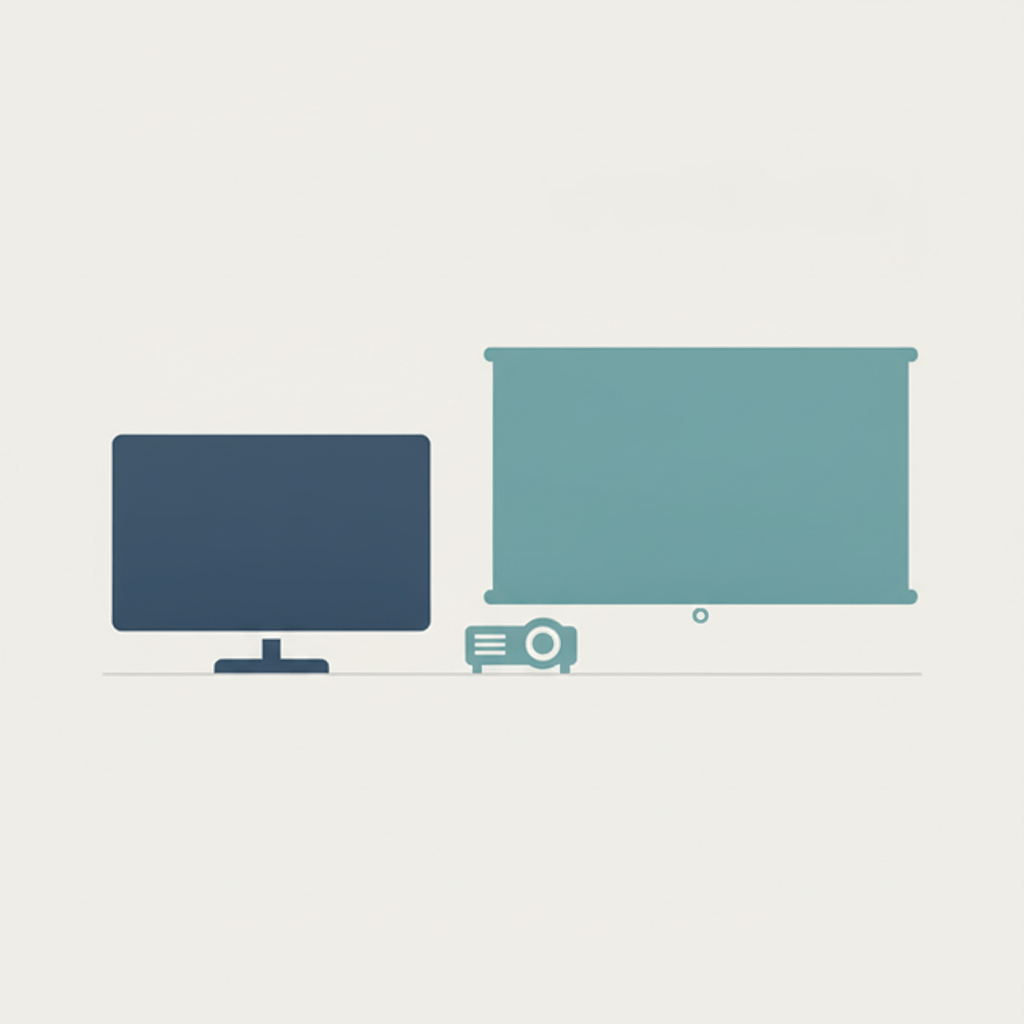
What room size do you need for a projector? Smaller than most US-written guides assume, but the ceiling height detail catches people out. UK homes typically have ceilings around 2.4m, with the DLUHC national space standard setting a 2.3m minimum over at least 75% of floor area in new-build habitable rooms — some new-build flats sit as low as 2.1–2.3m, London has a higher 2.5m minimum. That’s meaningfully lower than the 8–10ft (2.44–3.05m) figure US home-cinema content assumes for a dedicated media room.
Why does ceiling height matter? Standard-throw projectors (roughly 1.2:1–2.0:1 throw ratio) are usually ceiling- or shelf-mounted a few metres back from the screen, and in a low UK ceiling that position can end up awkwardly close to head height or clash with a light fitting — a detail spacious American room content skips entirely. This is where ultra short throw (UST) projectors earn their keep: a UST model throws a 100-inch image from just 20–50cm of wall clearance, sitting on a low unit rather than hanging from the ceiling, which suits tighter UK floor space and avoids chasing cables across a low ceiling.
Before buying, measure your actual wall-to-seating distance and check the model’s throw ratio against it — a projector needing 3.5m of clearance for a 100-inch image won’t work in a boxy UK terrace lounge, however good it looks in a manufacturer’s demo room.
Sound: The Extra Cost Projector Guides Leave Out
Do projectors have good enough built-in sound, or do you need a soundbar? Almost every projector guide underplays this, but the honest answer is: budget on needing one. Projector chassis are thin and built to be light and easy to position, leaving little room for decent speaker drivers — built-in audio is typically tinny and quiet, fine for casual daytime background viewing but not for following dialogue in a film. A TV’s built-in speakers are mediocre too, but “mediocre and adequate” is a real step up from “barely there”. If you already own a soundbar this isn’t a factor; if you don’t, it’s a genuine added cost competitor guides consistently gloss over — budget it in from day one, not as an afterthought.
Practically, that means the real comparison isn’t “TV price vs projector price” — it’s “TV price vs projector price plus a soundbar you probably weren’t planning on”. Factor that in before you decide a projector is the cheaper route.
Running Costs: Bulbs, Lasers and Real Lifespan
How much does it cost to run a projector compared to a TV? A TV has no running cost beyond electricity — no consumables, no replacement schedule. A lamp-based projector does: bulbs last roughly 2,000–5,000 hours, and a replacement typically costs £50–£100+VAT (as of August 2026). At 3 hours a day, a 3,000-hour lamp lasts a bit under three years before you’re paying for a replacement — not a dealbreaker, but a real recurring cost a TV doesn’t have.
Is a laser projector better than a lamp projector? For running costs, generally yes. Laser and LED light sources are rated for roughly 20,000–30,000 hours (some premium models claim 50,000+), with no bulb to replace — decades of use before the light source meaningfully degrades. They cost more upfront, but if you’re keeping the projector for years, total ownership cost often ends up lower once you’ve priced in one or two bulb replacements on a cheaper model.
Can a projector replace a TV completely, or do you need both? For a lot of UK households, the honest answer is you end up with both — a TV for daytime and casual viewing, a projector for evening film nights in a dimmed room. That’s not a failure of either product; it’s matching each one to the light conditions it’s good at.
Two Projectors Worth Considering
This isn’t a full projector roundup — that’s a separate guide. These two are reference points for the two realistic UK buying scenarios above: testing the waters in a spare room, or going all-in on a UST setup as a living room centrepiece.
Budget Pick: Entry-Level 1080p/4K-Capable Projector
Budget projectors in the ~£130–£390 range (as of August 2026 — check current price via the link below) are a sensible way to test whether a projector suits your room before spending UST-level money. Expect native or upscaled 1080p resolution, 1,400–2,200 ANSI lumens depending on the model, and smart TV features on newer models. This tier is honest about its limits: it needs a dim room to look good, and the built-in speaker won’t match TV-level clarity. It makes most sense in a converted spare bedroom, garage conversion, or any room you can reliably dim — not your main daylight-facing living room.
Pros
- Low-risk way to try projector viewing without UST money
- Genuinely huge picture for the price in a dim room
- Portable — easy to move between rooms or use outdoors in summer
Cons
- Unwatchable with meaningful daylight in the room
- Built-in sound is not a substitute for a soundbar
UST Pick: Ultra Short Throw Projector for a Real Living Room
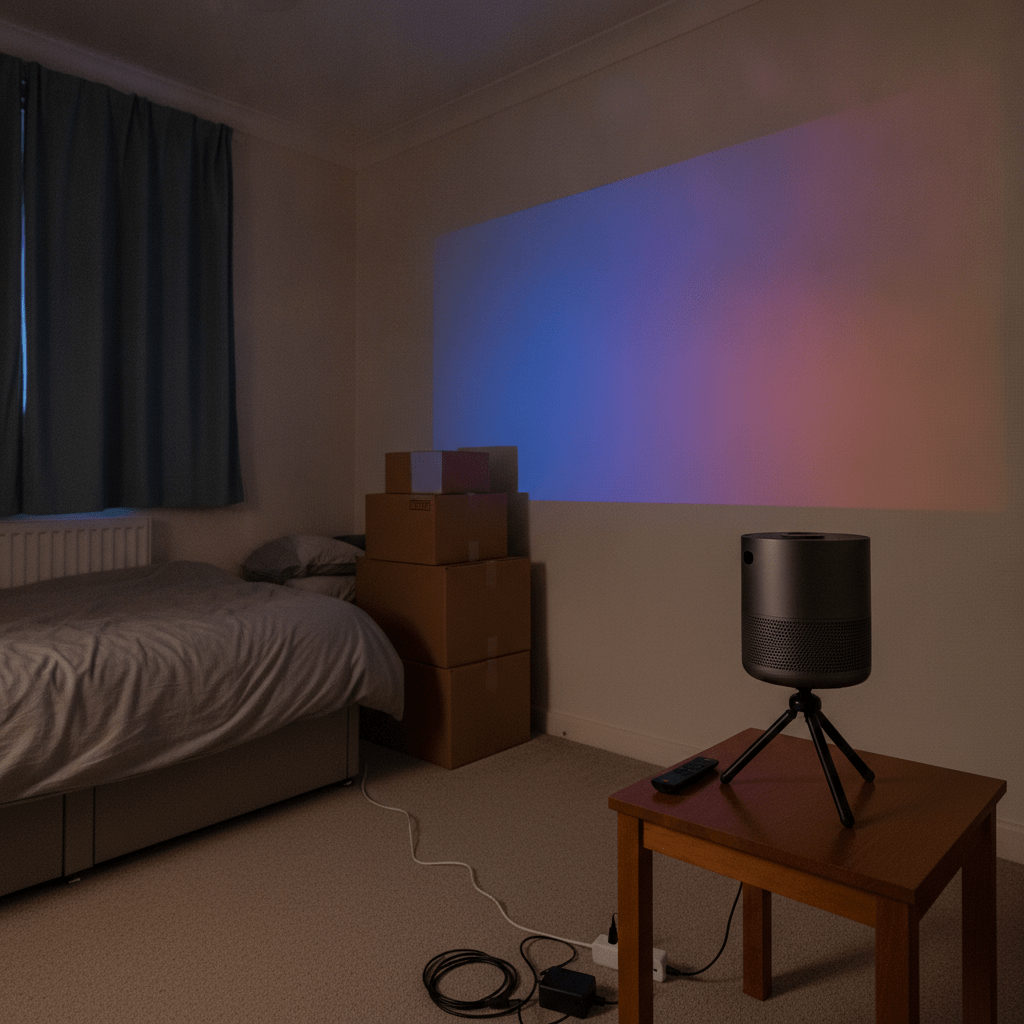
Ultra short throw projectors start from roughly £799 in the UK (as of August 2026 — check current price, this category moves quickly) and run to ~£2,000+ for premium laser models (as of August 2026). The appeal for UK homes is the throw distance: sitting 20–50cm from the wall on a low unit, a UST model avoids the ceiling-mount and low-ceiling headaches standard-throw projectors create, while still delivering a 100-inch-plus image. This tier generally uses laser light sources rather than lamps, avoiding the recurring bulb-replacement cost covered earlier — useful if this is a long-term fixture rather than occasional use. Pair it with a proper ALR screen rather than a plain wall for the sharpest result, and budget for a soundbar from the outset — UST models are no exception to the sound limitation covered above.
Pros
- No ceiling mount needed — fits a low UK ceiling and tighter floor space
- Laser light source avoids ongoing bulb-replacement costs
- Genuinely huge, cinema-scale image for the price
Cons
- Significant upfront cost versus a similarly sized standard-throw model
- Still needs a dimmable room and a separate sound system to shine
Companion Buy: A Soundbar for Your Projector
Given the sound gap covered earlier, a compact soundbar is the single most useful add-on for any projector setup — the difference between “watchable” and “actually enjoyable” beyond casual daytime viewing. You don’t need a full surround system; even an entry-level soundbar is a big step up from a projector’s built-in speaker.
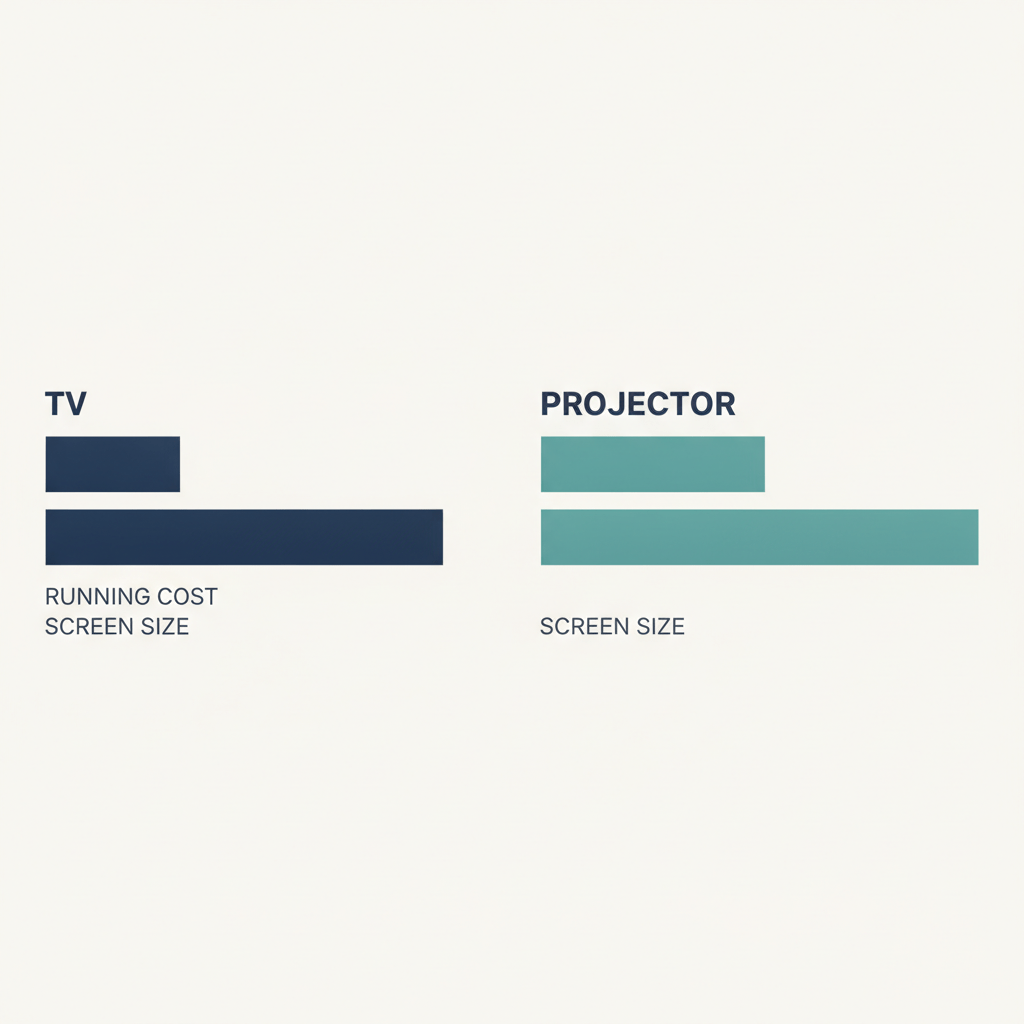
Full Comparison: TV vs Projector Specs and Costs
| TV | Budget projector | UST projector | |
|---|---|---|---|
| Typical UK entry price | ~£350+ (55-inch 4K) | ~£130–£390 | ~£799+ |
| Brightness for daylight use | Not applicable — self-lit | Poor (1,000–2,200 ANSI lumens typical) | Better, but still needs dim room for best results |
| Max realistic screen size | Up to ~85-inch before cost jumps sharply | 100-inch+ (image quality drops with distance) | 100-inch+ at close wall range |
| Setup | Plug and play | Positioning, focus, often a stand | Low unit against wall, minimal ceiling clearance needed |
| Sound | Built-in, mediocre but usable | Built-in, weak — soundbar recommended | Built-in, weak — soundbar recommended |
| Light source lifespan | Not applicable | ~2,000–5,000 hrs (lamp) | ~20,000–30,000 hrs (laser) |
| Replacement cost | None | ~£50–£100+VAT per bulb | None expected (laser) |
| Best UK room | Any room with normal daylight | Dimmable spare room or occasional use | Living room you can dim for evening use |
Which Is Right for You? A Room-by-Room Verdict
Is a projector better than a TV for a living room? It depends on your specific room, not the category in the abstract — here’s how that plays out across common UK living situations.
Small flat or open-plan lounge-diner
Buy a TV for either. A small flat rarely has the wall-to-seating distance a projector needs, and open-plan spaces are just as hard to darken — there’s often a second window or glass door letting in light at an angle that one blackout curtain won’t fix. A 43–55-inch 4K TV costs less and saves you fighting ambient light every evening; if you’re set on a projector in an open-plan space, a UST model with a proper ALR screen copes better than a budget one on a plain wall.
Converted spare bedroom or garage
This is the projector’s best-case scenario in a UK home — a room already separate from daily daytime life, easy to fit with cheap blackout curtains, and not competing with a TV for the same space. Start with the entry-level pick above before committing to UST-level spend.
Dedicated media room (rare in the UK, but it exists)
If you have a room used only for evening viewing, with blackout already sorted, a UST or standard-throw laser projector is a legitimate TV replacement here, not just a supplement — the one UK scenario where the American “dedicated cinema room” assumption actually holds.
Gaming-focused setup
Is a TV or projector better for gaming? For competitive or fast-paced gaming, a TV wins — lower input lag, higher refresh rates, and no reliance on a dim room. Projectors suit relaxed, story-driven gaming on a big screen in the evening, but check a model’s input lag first if responsiveness matters.
Once you’ve settled on a TV, our wall mounting guide covers the next step — VESA compatibility, wall type, and cable routing for a UK installation.
How to Decide: A Quick Checklist
Run through this before you buy either one:
- Measure the actual daylight your main room gets between 9am and 9pm across a normal week — be honest, not aspirational.
- Check whether the room can be blacked out for under £150–£200, or whether that’s unrealistic.
- Measure your wall-to-seating distance against a projector’s stated throw ratio before assuming a given screen size is achievable.
- Check your ceiling height for a standard-throw model — UK ceilings around 2.3–2.5m can make ceiling mounting awkward.
- Budget a soundbar into any projector purchase from the start.
- Decide laser (higher upfront cost, no bulb replacement) or lamp (cheaper upfront, recurring bulb cost).
- Still unsure? Buy the TV first — the lower-risk choice for most UK rooms, and you can add a projector later for a dark-room setup.
FAQ: TV vs Projector UK
Is a projector better than a TV for a living room?
A projector only beats a TV for a living room if that room can be reliably dimmed — otherwise a TV wins on picture quality, convenience, and sound. Most UK living rooms get regular daylight and double as multi-purpose family spaces, which favours a TV despite the projector’s bigger screen for the money.
Do projectors work in daylight or bright rooms?
Most projectors struggle badly in daylight — guides commonly cite around 3,000 ANSI lumens as the point where a projector stays watchable with some ambient light, and most budget models fall well short of that. Treat any projector purchase as needing a room you can dim, not one used with the curtains open.
How much does it cost to run a projector compared to a TV?
A TV has no running cost beyond electricity, while a lamp-based projector adds a bulb replacement roughly every 2,000–5,000 hours, costing around £50–£100+VAT each time (as of August 2026). Laser projectors avoid this cost, rated for 20,000–30,000+ hours, but cost more upfront.
Is a 100-inch projector cheaper than a 100-inch TV?
Yes, generally — a 98–100-inch class TV costs roughly £1,400–£5,000+ (as of August 2026), while a 100-inch projector setup including a proper screen lands around £1,500–£2,500. Screen material doesn’t scale in cost the way TV panels do, so the gap widens further at 120 inches and beyond.
Do you need blackout curtains or blinds for a projector?
For most UK living rooms, yes — blackout curtains or blinds are effectively required to get picture quality above “watchable in a pinch”. Budget roughly ~£100–£200 for this if your room doesn’t already have proper light control (as of August 2026).
Do projectors have good enough built-in sound, or do you need a soundbar?
Projector built-in sound is almost never good enough beyond casual daytime viewing — the thin chassis leaves little room for decent speaker drivers. Budget a soundbar into the purchase from the outset rather than treating it as optional.
How long do projector bulbs last, and how much is a replacement?
Traditional projector lamps last roughly 2,000–5,000 hours before noticeably dimming, and a replacement typically costs around £50–£100+VAT (as of August 2026). At three hours a day, that’s somewhere between under two and just over four years before you’re paying for a new one.
What room size do you need for a projector?
You need wall-to-seating clearance that matches the projector’s throw ratio — standard-throw models need several metres for a large image, while ultra short throw (UST) models manage a 100-inch picture from just 20–50cm of wall clearance. UK ceiling height matters too, since UK homes average around 2.4m versus the 8–10ft US media-room assumption.
Is a laser projector better than a lamp projector?
A laser projector is generally the better long-term choice: the light source lasts 20,000–30,000+ hours with no bulb to replace, versus a lamp’s 2,000–5,000-hour lifespan. Lamp projectors stay cheaper upfront, which makes sense if you’re testing whether a projector suits your room before laser-tier spend.
Can a projector replace a TV completely, or do you need both?
A projector can fully replace a TV only if your main room can be dimmed for daytime as well as evening use — true of relatively few UK living rooms. Most UK households that own a projector keep a TV too: it covers daytime viewing, the projector comes out for evening films.
Ready to Choose? Compare Prices Now
Whichever way you land, check current prices before you buy — both TV and projector pricing shift often in the UK market.
Prices and specifications change frequently — always check the current price via the links above before buying. We update this guide as UK pricing shifts.

Written by the TheTechVector Team
We research UK broadband, VPN, laptop, and mobile deals so you don’t have to. All prices are checked before publication — if something’s out of date, let us know.
This site contains affiliate links to products. We may receive a commission for purchases made through these links.