Affiliate disclosure: TheTechVector earns a commission if you sign up via links on this page, at no extra cost to you. Our recommendations are based on independent research — we are not paid to favour any provider. Learn more about how we make money.
This Sky broadband review UK for 2026 covers everything you actually need to know before signing up: real package prices, the router you’ll get, how Sky’s customer service holds up against the official data, and the small print that catches people out — including a price-rise mechanism that genuinely works differently to most of its rivals.
Last updated: September 2026
Sky Broadband Review UK: At a Glance
Sky broadband runs mainly on the Openreach network, with full fibre also available through CityFibre in some areas, and prices currently range from roughly £23/mo for its entry Superfast package up to ~£35/mo for the 2.5Gbps Full Fibre tier (as of September 2026, based on live listings from Uswitch, MoneySuperMarket and broadbandchoices.co.uk). Every package now runs on a 24-month contract, and — unlike some rivals — Sky doesn’t build an annual mid-contract price rise into that contract at all.
What makes Sky an odd one to review honestly is that the official complaints data and the independent satisfaction surveys tell two very different stories. Ofcom’s own Q1 2026 figures put Sky as the second-best provider in the UK for complaints. Which?’s July 2026 customer survey ranks it 9th out of 12. Both are real, dated, credible sources — and we’ve broken down why they disagree further down this article, because no other review we checked bothers to.
Pros
- 2nd-lowest Ofcom complaints rate in the UK, Q1 2026 (5 per 100,000 customers)
- No mid-contract annual price rise — price is fixed for the full 24-month term
- Speeds up to 5,000Mbps symmetrical on the top CityFibre tier
- Free Sky Broadband Shield parental controls and malware protection on every package
- Sensible router tiering — you’re not stuck with a budget hub on a gigabit package
Cons
- Ranked 9th of 12 providers in Which?’s July 2026 satisfaction survey
- Reliability scored just 53% in Expert Reviews’ own survey — one of the lowest in their table
- Whole-home WiFi Max add-on isn’t included and costs £4–£10/mo extra on most tiers
- 24-month contracts are long if your circumstances might change
- Some conflicting information on setup fees between Sky’s own small print and comparison sites
What Broadband Packages Does Sky Offer in 2026? (Openreach vs CityFibre)
Sky offers nine broadband tiers as of September 2026, running from a part-fibre 35Mbps entry package up to a symmetrical 5,000Mbps full fibre package. Most of the range sits on the Openreach network, which reaches the vast majority of UK homes, but Sky also sells full fibre through CityFibre in CityFibre’s own coverage areas — and which network is available at your postcode genuinely changes both the price and the speed on offer.
The line-up (speeds confirmed via sky.com, snapshot September 2026 — always double-check availability at your own postcode before signing up):
| Package | Speed (down/up) | Network |
|---|---|---|
| Superfast 35 | 35Mbps / 9Mbps | Openreach (part-fibre) |
| Superfast | 67Mbps / 16Mbps | Openreach (part-fibre) |
| Full Fibre 75 | 75Mbps / 16Mbps | Openreach FTTP |
| Ultrafast | 145Mbps / 27Mbps | Openreach G.Fast (limited availability) |
| Full Fibre 150 | 150Mbps / 27Mbps | Openreach FTTP |
| Full Fibre 500 | 500Mbps / 60Mbps | Openreach FTTP |
| Full Fibre Gigafast | 900Mbps / 90Mbps | Openreach FTTP |
| Full Fibre 2.5 Gigafast+ | 2,500Mbps / 2,500Mbps | CityFibre (symmetrical) |
| Full Fibre 5 Gigafast+ | 5,000Mbps / 5,000Mbps | CityFibre (symmetrical) |
Note: broadbandchoices.co.uk still lists a legacy “Sky Broadband Essential” ADSL tier around 11Mbps as of its September 2026 listing, but this doesn’t appear on Sky’s own current package page or Uswitch’s live pricing — treat it as something to confirm directly at signup rather than a current live option.
Openreach and CityFibre pricing doesn’t always follow the pattern you’d expect. It’s not always the case that CityFibre is cheaper, or that Openreach is cheaper — it genuinely varies tier by tier and postcode by postcode, so check both networks where you live rather than assuming one is always the better deal. For a plain-English explainer of what full fibre actually means and how UK coverage works, our full fibre broadband explainer covers the Openreach vs CityFibre vs Virgin Media split in more depth than we can fit into a single-provider review.
Sky Broadband Prices: The 24-Month Total Cost
Sky broadband prices currently range from ~£23/mo to ~£35/mo depending on the tier, and every package we found runs on a 24-month contract (as of September 2026). Because live pricing shifts between comparison sites and Sky’s own promotions, we’re presenting these as ranges rather than one fixed figure — confirm the exact price at checkout before you commit.
| Package | Price range (as of Aug–Sept 2026) | Contract |
|---|---|---|
| Superfast / Superfast 35 | ~£23–24/mo | 24 months |
| Full Fibre 75 | ~£23–25/mo | 24 months |
| Full Fibre 150 | ~£24/mo | 24 months |
| Full Fibre 500 | ~£26–27/mo | 24 months |
| Full Fibre Gigafast (900Mbps) | ~£25–29/mo | 24 months |
| Full Fibre 2.5 Gigafast+ | ~£35/mo | 24 months |
Sources: Uswitch (September 2026), MoneySuperMarket (August 2026), broadbandchoices.co.uk (September 2026) and MoneySavingExpert (August 2026) — all cross-checked, with the spread reflecting genuine promotional variation rather than one site being wrong.
On setup costs, there’s a real discrepancy worth flagging rather than glossing over. Every third-party comparison site we checked shows £0 upfront for Sky broadband, but Sky’s own small print (sky.com, snapshot September 2026) mentions a possible £9.95 router delivery charge plus a £10 activation fee. We’re presenting both rather than picking one — confirm exactly what you’ll pay at checkout before you sign the contract.
Here’s the part that genuinely sets Sky apart from most of the market: Sky has avoided putting a mid-contract, in-term price-rise clause into its broadband contracts (Which?, updated 26 July 2026). Your price is fixed for the full 24-month term. When that term ends, if you don’t switch or renegotiate, you roll onto a new contract and the price typically steps up by a flat +£5/mo — not an annual creeping rise every April like some rivals apply. Take a Full Fibre 150 package at ~£24/mo: over 24 months that’s roughly £576 total, with no surprise increases in between, versus a provider that raises prices every April on top of your base rate.
That doesn’t mean Sky prices never move. In April 2026, Sky did raise prices by around £3/mo for many existing broadband and TV customers, including people who were still mid-contract at the time — but this was a specific, one-off event, not evidence of a recurring annual clause. Customers had a 30-day window from the announcement date (not the implementation date) to leave broadband penalty-free, though that exit right didn’t apply if you also had a Sky TV contract. Confirm the exact terms directly with Sky if this is relevant to you, since policies can be updated.
If you want to see how Sky’s pricing sits against the rest of the market before deciding, our roundup where you can compare all UK broadband providers is a good next stop.

Sky Broadband Speeds: What to Expect on Each Tier
Sky’s headline speeds range from 35Mbps on Superfast 35 up to a symmetrical 5,000Mbps on the top CityFibre tier — but headline speed and what you’ll actually get in daily use aren’t always the same thing. Part-fibre packages like Superfast 35 and Superfast share the final stretch of copper cabling into your home, so real-world speeds can dip below the advertised figure, especially at peak times or in a large household.
Full fibre tiers (Full Fibre 75 upwards) run fibre all the way to your property, so you should get much closer to the advertised speed consistently. For most households, Full Fibre 75 or Full Fibre 150 is plenty for multiple people streaming in 4K, video calling and gaming at the same time. If you’re not sure how much speed your household actually needs, our guide on how much speed you actually need breaks it down by household size and use case rather than just pushing you toward the fastest (and priciest) tier.
The gigabit-plus tiers — Full Fibre Gigafast and the two Gigafast+ packages — are overkill for most single-household streaming and browsing, but they make sense if you’ve got a houseful of heavy users, run a home server, or genuinely need fast, symmetrical upload speeds for things like large video uploads or cloud backups.
The Sky Broadband Hub: Which Router Do You Get?
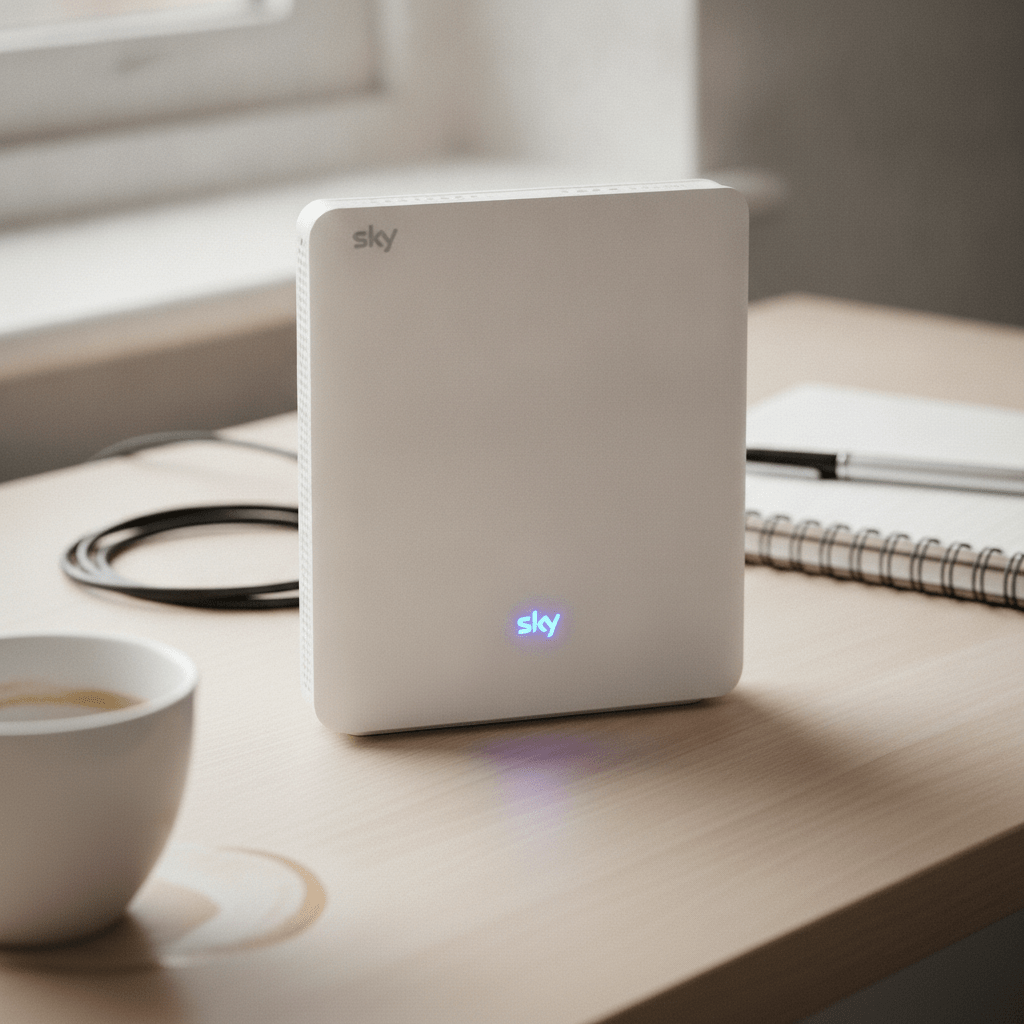
Sky’s router depends on which package you sign up for — it’s not a single device across the whole range. Standard and lower-tier packages get the plain Sky Hub. Full Fibre 500 and Full Fibre Gigafast (900Mbps) customers get the Sky Hub Max, which runs Wi-Fi 6. The top-tier Full Fibre 5 Gigafast+ package on CityFibre ships with the Gigafast+ hub, which uses Wi-Fi 7 (Which?, updated 26 July 2026; confirmed separately by Expert Reviews, modified February 2026).
That tiering matters in practice — you’re not stuck with a budget router on a package fast enough to need better hardware, but equally, don’t assume every Sky customer gets the same Wi-Fi 6 or Wi-Fi 7 kit. If you’re wondering whether your bundled router is actually up to the job of a full fibre line, our piece on whether you need a new router for full fibre is worth reading before you decide to upgrade separately.
If your home has dead spots even with the right router, Sky sells a whole-home Wi-Fi add-on called WiFi Max. It isn’t included by default and costs between £4 and £10/mo depending on your base package (it’s free on the Full Fibre 5 Gigafast+ tier), covering an upgraded router plus extenders and a 10Mbps or 25Mbps per-room speed guarantee. One genuinely important detail most competitor reviews miss: WiFi Max carries its own separate 24-month minimum term, with its own penalty charges if you cancel it apart from your main broadband contract (Which?, 26 July 2026) — so don’t add it on a whim expecting to drop it whenever you like.
Every Sky package also includes Sky Broadband Shield at no extra cost — free parental controls and phishing/malware protection built into the router. It’s genuinely useful for households with kids or anyone who wants a basic safety net, but it’s not a substitute for proper antivirus software on your actual devices, and it won’t catch everything a dedicated security suite would.
Sky Broadband Customer Service: Ofcom vs Which? — Two Very Different Pictures
Ofcom’s Q1 2026 complaints data ranks Sky as the second-best broadband provider in the UK, while Which?’s July 2026 customer survey ranks it 9th out of 12 — and both figures are genuine, dated and credible. Here’s why they don’t agree.
Ofcom’s figures (published 23 July 2026, covering January–March 2026) show Sky receiving just 5 complaints per 100,000 customers, behind only Plusnet on 4, and comfortably ahead of the industry average of 6 — itself an all-time record low. TalkTalk was worst on 10 per 100,000. But Ofcom’s complaints figure only measures complaints that were formally escalated through an Alternative Dispute Resolution scheme — a specific, narrow slice of genuinely unhappy customers, not a general satisfaction score.
Which?’s survey (updated 26 July 2026) measures broader day-to-day customer satisfaction from a much wider respondent pool, and there Sky scored 62%, placing it 9th of 12 providers. Expert Reviews’ own separate survey (fieldwork conducted September 2025, published/updated 25 February 2026, roughly 1,544 UK respondents) tells a similar story: Sky scored 79% for value, 77% for customer service and 86% for speed — numbers that look fine in isolation — but only 53% for reliability, the second-worst score in their entire table, described as “bottom half of the table” across nearly every category.
Put together honestly: Sky is unlikely to give you a reason to formally escalate a complaint, but plenty of everyday Sky customers report a mediocre day-to-day experience, particularly around reliability. If rock-solid uptime matters more to you than an unblemished complaints record, this is worth weighing carefully rather than just looking at the Ofcom headline figure.
Sky Broadband vs BT, EE, TalkTalk and Virgin Media
Sky’s closest comparison is usually BT, given the shared Openreach heritage and similar full fibre coverage — we’ve broken that specific match-up down in detail in how BT and Sky compare, including where each one wins on price and contract terms.
Against EE, Sky’s pricing is broadly competitive on the mid-range full fibre tiers, though EE has leaned harder into Wi-Fi 7 router hardware across more of its range — see our full EE broadband review for the detail. TalkTalk tends to undercut Sky on headline price at the budget end, but Sky’s Ofcom complaints performance is considerably stronger — our TalkTalk broadband review covers where that budget positioning genuinely pays off and where it doesn’t.
If raw top-end speed is your priority, Virgin Media’s cable network can outpace Sky’s Openreach tiers on download speed for a similar price, though Sky’s CityFibre-based Gigafast+ tiers now compete directly on symmetrical upload speed — read our Virgin Media broadband review for the full comparison. And if you’re weighing Sky against another full fibre-first provider, our Vodafone broadband review is worth a look too, particularly if CityFibre availability is a factor at your postcode.
Sky Broadband Review UK 2026: Verdict — Who Should Choose Sky?
Choose Sky if…
You want a provider with one of the lowest formal complaints rates in the UK, a genuinely simple price-rise structure (fixed for the full 24-month term, then one flat step at renewal), and free malware/parental-control protection bundled in as standard. Sky is also a solid pick if you already have Sky TV or Sky Mobile and want everything under one account.
Consider an alternative if…
Day-to-day reliability matters more to you than an unblemished complaints record — Expert Reviews’ own survey data suggests Sky isn’t the most consistent performer here. You should also look elsewhere if you want whole-home Wi-Fi included as standard rather than as a separate 24-month add-on, or if you’re not comfortable committing to a 24-month contract in the first place.
How to Switch to Sky Broadband — Step by Step
- Check availability and pricing for your exact postcode on Sky’s own site, since speeds and prices vary between Openreach and CityFibre areas.
- Compare the quote against your current deal, including any exit fees you might owe your existing provider.
- If you’re switching between most major providers, Sky can usually handle the switch for you through the industry’s One Touch Switch process, so you don’t need to give notice to your old provider yourself.
- Check the early termination fee page on Sky’s own site directly before switching if you’re still mid-contract elsewhere, and confirm the setup/activation cost that applies to your specific order.
- Book your installation date — full fibre installs may need an Openreach or CityFibre engineer visit, so leave a few weeks’ buffer if your current contract end date is fixed.
- Once installed, test your speed at different times of day for the first week to confirm you’re getting close to the advertised figure.
For a fuller walkthrough that applies across providers, not just Sky, see our guide on how to switch broadband.
Frequently Asked Questions
Is Sky broadband any good in 2026?
Sky broadband is genuinely strong on official complaints data — Ofcom’s Q1 2026 figures rank it 2nd-lowest in the UK for complaints — but weaker on broader satisfaction surveys, ranking 9th of 12 in Which?’s July 2026 survey and scoring only 53% for reliability in Expert Reviews’ own research. It’s a solid, low-hassle option, but not the most consistently reliable performer in the market.
How much does Sky broadband cost per month?
Sky broadband prices range from roughly £23/mo on the entry Superfast package to around £35/mo for the 2.5Gbps full fibre tier, based on live listings from Uswitch, MoneySuperMarket and broadbandchoices.co.uk (as of August–September 2026). All current packages run on 24-month contracts — confirm the exact price for your postcode before signing up.
Does Sky put up broadband prices every year?
No — Sky has avoided building an annual mid-contract price-rise clause into its broadband contracts (Which?, updated 26 July 2026). Your price is fixed for the full 24-month term, and typically only rises by a flat +£5/mo when you roll onto a new contract at renewal. Sky did apply a one-off ~£3/mo rise in April 2026 for many existing customers, but that was a specific event, not an ongoing annual policy.
What router does Sky broadband give you?
Sky’s router depends on your package. Standard and lower-tier customers get the plain Sky Hub. Full Fibre 500 and Full Fibre Gigafast (900Mbps) customers get the Sky Hub Max with Wi-Fi 6. The top Full Fibre 5 Gigafast+ tier on CityFibre ships with the Gigafast+ hub, running Wi-Fi 7 (Which?, 26 July 2026).
Is Sky broadband available in my area?
Sky broadband is widely available across the UK via the Openreach network, with full fibre also offered through CityFibre in CityFibre’s own coverage areas. Availability, speed and price can all vary by postcode and by which wholesale network reaches your address, so it’s worth checking directly on Sky’s site rather than assuming your neighbour’s deal applies to you too.
Is Sky or BT, Virgin Media, or TalkTalk broadband better?
It depends what you value most. Sky edges out BT and TalkTalk on Ofcom’s official complaints ranking and offers a simpler price-rise structure than some rivals. Virgin Media can beat Sky on raw download speed for a similar price via its cable network. TalkTalk tends to undercut Sky on headline price at the budget end. See our dedicated BT vs Sky comparison for a direct breakdown.
What is Sky WiFi Max and is it worth paying for?
Sky WiFi Max is a whole-home Wi-Fi add-on costing £4–£10/mo depending on your base package (free on the top Full Fibre 5 Gigafast+ tier), including an upgraded router, extenders, and a 10Mbps or 25Mbps per-room speed guarantee. It’s worth it if you have genuine Wi-Fi dead spots in a larger home, but it carries its own separate 24-month minimum term with its own cancellation penalties, so it’s not a casual add-on to try and drop later.
Can I get Sky broadband without Sky TV?
Yes, Sky sells standalone broadband packages without requiring a Sky TV subscription. Bundling with Sky TV or Sky Mobile can sometimes unlock a better overall deal, but it’s entirely optional — check current standalone broadband pricing directly against any bundle offer before deciding.
How do I cancel Sky broadband and what are the early termination fees?
Sky’s early termination fee is based on the remaining months left on your contract, but the exact figure varies by package and should be confirmed directly on Sky’s own help pages before you commit to cancelling. If you’re leaving during a specific price-rise window — such as the 30-day exit period following the April 2026 rise announcement — you may be able to leave broadband penalty-free, though this exception didn’t apply to customers who also had a Sky TV contract.
Is Sky broadband on an 18-month or 24-month contract?
Sky’s standard broadband contract is now 24 months across its current package range (Which?, updated 26 July 2026, confirmed independently by Uswitch, MoneySuperMarket and broadbandchoices.co.uk). Older content citing 18-month Sky contracts is out of date — 24 months is the current figure as of late 2026.
Sky Broadband Deals: Final Word
Ready to check Sky Broadband deals for your postcode? Prices and availability vary by area, so it’s worth checking directly before you commit.
Sky Broadband’s affiliate programme is not currently generating tracked commission through this article — the CTAs above link straight to Sky’s own site so you can check current deals directly. Prices, package names and terms mentioned in this article were accurate as of the source dates cited throughout and can change — always confirm current pricing and contract terms directly with the provider before signing up. Our recommendations are based on independent research and we are not paid to favour any provider. Learn more about how we make money.

Written by the TheTechVector Team
We research UK broadband, VPN, laptop, and mobile deals so you don’t have to. All prices are checked before publication — if something’s out of date, let us know.
This site contains affiliate links to products. We may receive a commission for purchases made through these links.