Affiliate disclosure: TheTechVector earns a commission if you sign up via links on this page, at no extra cost to you. Our recommendations are based on independent research — we are not paid to favour any provider. Learn more about how we make money.
Full fibre broadband (FTTP) is the fastest, most reliable type of home internet connection available in the UK, and it’s now available to more than four in five homes — but working out whether you actually have access to it, and which provider to pick, is more confusing than it should be. This guide explains what full fibre actually is, how it’s different from the FTTC and cable broadband most of the UK grew up on, exactly which network (Openreach, CityFibre, or Virgin Media’s own build) each major provider sells over, and how to check what’s really available at your address.
Last updated: August 2026
Full Fibre at a Glance
Before the detail, here’s the short version. All the providers below sell genuine FTTP — the difference is which physical network carries it to your house, and that affects price, router hardware, and whether it’s even available on your street yet.
| Provider | Network it uses | Entry FTTP price | Contract length |
|---|---|---|---|
| BT | Openreach | ~£28.99/mo (as of August 2026) | 24 months |
| EE | Openreach | ~£29.99/mo (as of August 2026) | 24 months |
| Plusnet | Openreach | ~£22.99/mo promo (as of August 2026) | 24 months |
| TalkTalk | Openreach + CityFibre (varies by street) | ~£26/mo (as of August 2026) | 24 months |
| Sky | Openreach + CityFibre (varies by street) | ~£28/mo (as of August 2026) | 18 months |
| Vodafone | CityFibre | ~£26/mo (as of July 2026) | 24 months |
| Virgin Media | Own network (cable + Nexfibre FTTP) | ~£27/mo (as of August 2026) | 18 months |
Quick Verdicts
Best value full fibre
Plusnet’s promotional Full Fibre pricing beats every major Openreach reseller, and it’s still backed by BT’s own network reliability.
Best for guaranteed speeds
BT’s Openreach FTTP comes with the widest coverage and a speed guarantee written into the contract — useful if you’ve been burned by patchy broadband before.
Best for checking every option
Broadband Genie compares full fibre deals from BT, EE, TalkTalk, Sky, Vodafone, and more against your actual postcode in one search.
What Is Full Fibre (FTTP) Broadband?
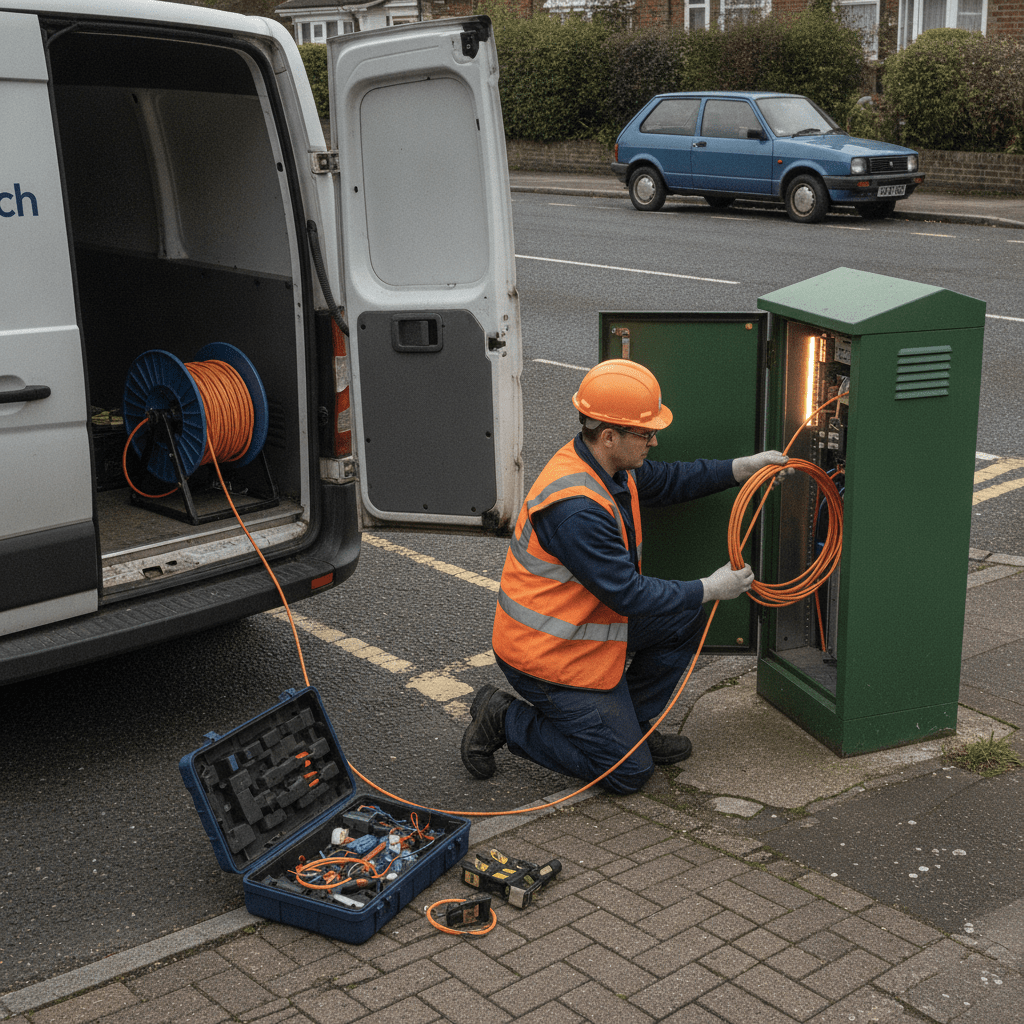
Full fibre broadband means fibre-optic cable runs the entire distance from the telephone exchange (or a local aggregation point) all the way into your house, with no copper wire anywhere in the connection. FTTP stands for “fibre to the premises” — the cable literally terminates at your property, usually on a small box on an outside wall.
That matters because fibre-optic cable carries data as pulses of light rather than electrical signals, so it doesn’t degrade over distance the way copper does. A full fibre connection can realistically support speeds from around 150Mbps up to multi-gigabit, with upload speeds that actually match your download speed on many packages — something copper-based broadband has never managed.
It’s worth being precise about the terminology here, because providers and comparison sites use “fibre broadband” loosely. Not every package marketed as “fibre” is full fibre, and that’s exactly where most buying mistakes happen — covered in the next section.
Full Fibre vs FTTC vs Cable: What’s Actually Different
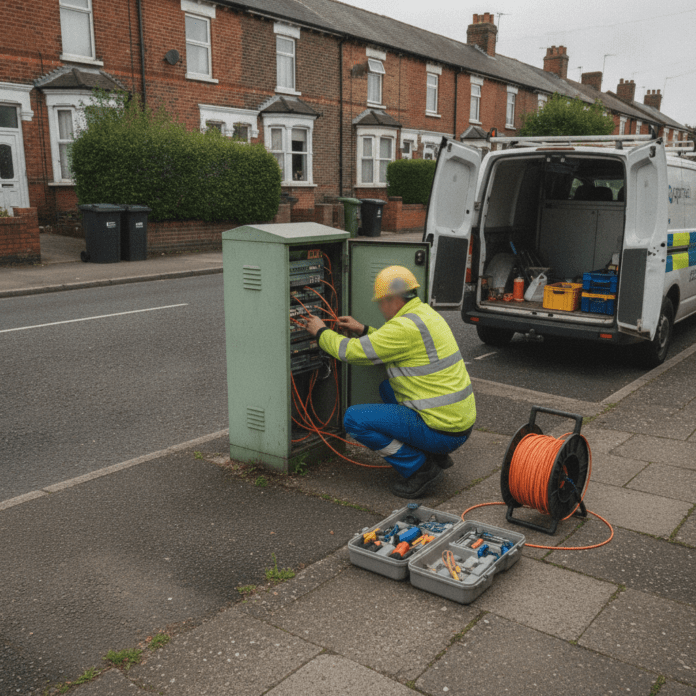
FTTC (fibre to the cabinet) is the “fibre broadband” most UK homes have had since the 2010s. Fibre runs from the exchange to the green cabinet at the end of your street, then the final stretch into your house is still old copper telephone wire. That copper section is the bottleneck — FTTC tops out around 80Mbps download and 20Mbps upload, and both numbers drop the further your house is from the cabinet.
Virgin Media’s network is a different case again. Its legacy Gig1 service runs over coaxial cable (DOCSIS technology), not fibre-optic cable, right to the home. It’s genuinely fast — up to around 1,130Mbps download — but it isn’t full fibre in the strict FTTP sense. Only areas upgraded through Virgin’s Nexfibre build, or homes on the newer Hub 5X in confirmed FTTP zones, are running true fibre-to-the-premises. This is one of the most-searched questions about full fibre, and most guides fudge the answer — Virgin’s cable service and Virgin’s FTTP service are genuinely different technologies sold under the same brand.
Full fibre (FTTP) pros
- No copper bottleneck — speed doesn’t drop with distance from the cabinet
- Upload speeds usually match or come close to download speeds
- More reliable in bad weather than copper, which is prone to water ingress faults
- Future-proof against the PSTN copper switch-off (more on that below)
Full fibre cons
- Not available everywhere yet — postcode-dependent, sometimes street-by-street
- Usually a little more expensive than FTTC on equivalent speed tiers
- Installation may need an engineer visit to fit a new box on the outside wall
If you’re still unsure whether your current router can even handle full fibre speeds once you switch, we’ve covered whether you need a new router for full fibre in a separate guide.
How Much of the UK Has Full Fibre in 2026?
UK full fibre coverage sits between 82% and 85% of premises in 2026, depending on which source you check and when. Ofcom’s Spring 2026 update put FTTP availability at 82% of UK premises, based on data collected as of January 2026 — up from 78% in July 2025. thinkbroadband, which tracks coverage continuously rather than in periodic snapshots, recorded 85.38% as of Friday 14 August 2026.
Neither figure is wrong. Ofcom’s number is an official audited snapshot published months after the data was collected; thinkbroadband’s is a live rolling count that updates as new streets go live. Don’t average the two or assume one “corrects” the other — they’re simply measuring at different moments. Also worth knowing: gigabit-capable broadband, a broader category that includes full fibre plus upgraded cable networks like Virgin’s, covers a larger 89–91% of UK premises on the same Ofcom/ISPreview reporting. Gigabit-capable and full fibre are not the same thing, even though they’re often quoted in the same breath.
Coverage also varies hugely by which network actually reaches your street, which is the part most guides skip entirely.
- Openreach — the UK’s largest single network, wholesaling to BT, EE, Plusnet, TalkTalk, Sky, and others — covered around 65% of UK premises as of early 2026, with a stated target of 25 million premises (roughly 85% of the UK, including 6.2 million rural and semi-rural homes) by December 2026.
- CityFibre — the second-largest network, wholesale-only and never sold direct to consumers — covered approximately 4.6 million UK premises as of October 2025, with more than 30 retail providers (including Vodafone, Sky, TalkTalk, and Zen Internet) selling over it, targeting up to 8 million premises.
- Virgin Media / Nexfibre — Virgin’s combined cable and Nexfibre FTTP footprint reached roughly 9 million premises by Q2 2026, up from 8.7 million in Q1 2026. Nexfibre specifically, Virgin’s joint venture with Telefónica/O2 to build new FTTP, had passed 2.6 million premises ready for service by 31 December 2025, with a target of 5 million more by the end of 2026.
Which UK Providers Offer Full Fibre?
Every major UK broadband brand now sells full fibre, but they don’t all build their own networks — most rent space on Openreach’s or CityFibre’s infrastructure, and a couple straddle both depending on your specific street. Knowing which network your provider actually uses matters, because it determines router hardware, installation timelines, and sometimes even whether a deal is available at all on your road.
| Provider | Network(s) | Standard router | Notes |
|---|---|---|---|
| BT | Openreach | Smart Hub 3 (Wi-Fi 6), launched May 2026 | Widest single-network coverage; speed guarantee included |
| EE | Openreach (BT Group) | Smart Hub 7 Plus (Wi-Fi 7, tri-band) | First major UK ISP with Wi-Fi 7 as standard, from December 2025 |
| Plusnet | Openreach (BT Group) | Wi-Fi 6 hub | Promo pricing rises by £4/mo in March 2027 and again in March 2028 |
| TalkTalk | Openreach + CityFibre | Wi-Fi Hub 3 / eero 6 / eero Pro 6, depending on tier | Sold as “Future Fibre” in 100+ UK towns; hardware varies by speed tier |
| Sky | Openreach + CityFibre | Wi-Fi 6 standard; Gigafast+ Hub (Wi-Fi 7) on CityFibre multi-gig tiers | Awin affiliate programme currently suspended — link goes direct to Sky |
| Vodafone | CityFibre | Power Hub (Wi-Fi 6); Ultra Hub 7 (Wi-Fi 7) on Pro 3 tier only | Full Fibre 910 from ~£26/mo (as of July 2026) |
| Virgin Media | Own network — cable (not full fibre) and Nexfibre (genuine FTTP) | Hub 5 (Wi-Fi 6) / Hub 5X in FTTP zones | Check which technology serves your address before assuming it’s FTTP |

CityFibre itself doesn’t sell to households directly — it’s worth knowing the name because it shows up on postcode checkers, but you’ll always be signing up through one of its retail partners. The same applies to smaller altnets like Hyperoptic and Community Fibre, which build their own local full fibre networks in specific towns and cities; if one of those shows up as available at your address, it’s genuinely worth comparing against the bigger names, though we haven’t reviewed them individually yet.
For a head-to-head on two of the most commonly compared full fibre resellers, our BT vs Sky comparison breaks down pricing and contract terms in more detail than fits here, and if budget is the priority, our cheapest full fibre deals guide tracks the lowest verified prices across every major provider.
How to Check If You Can Get Full Fibre at Your Address
You check full fibre availability by entering your postcode into a provider’s own checker, but a single checker often can’t see every network that reaches your street — which is the most common reason people wrongly conclude full fibre “isn’t available” where they live.
Here’s why: BT’s checker shows Openreach availability. Sky and TalkTalk’s checkers can show both Openreach and CityFibre results, but not always consistently. Vodafone’s checker only shows CityFibre. And Virgin Media’s checker only shows Virgin’s own network. If your street happens to be covered by CityFibre but not yet by Openreach — a genuinely common situation — a BT or EE checker will tell you full fibre isn’t available, when it actually is, just through a different provider.
- Start with a comparison tool like Broadband Genie, which checks multiple networks against your postcode in one search rather than just one provider’s own infrastructure.
- Cross-check with at least one individual provider’s checker from a different network — for example, try BT (Openreach) and Vodafone (CityFibre) separately if the comparison tool shows mixed or unclear results.
- If you’re a Virgin Media customer or considering Virgin, use Virgin’s own checker specifically — its network isn’t visible on Openreach or CityFibre-based tools at all.
- Note down which network(s) show as available, not just which providers — this tells you whether you have real choice or effectively one option.
- If nothing shows as available yet, check again in three to six months — Openreach, CityFibre, and Nexfibre are all still actively building, and previously unavailable postcodes go live regularly.
Once you’ve confirmed availability and you’re ready to compare actual packages, our full UK broadband provider comparison is the next logical stop, and if you decide to leave your current supplier, switching is easier than you think under Ofcom’s one-touch switching rules.
The Copper Switch-Off: Why Full Fibre Is Becoming Hard to Avoid
The UK’s analogue copper phone network (PSTN) is due to switch off completely on 31 January 2027, affecting an estimated 14 million homes and businesses still on analogue lines. This isn’t a distant deadline — Openreach is already migrating exchange areas one at a time, issuing “stop-sell” orders that block new copper-based orders in each area well ahead of the national cut-off.
That stop-sell process matters for broadband, not just landlines. ADSL and FTTC packages that rely on the copper line are being withdrawn area-by-area alongside the voice switch-off, which means FTTC isn’t a safe long-term choice if your exchange area is scheduled for early migration — even though the voice switch-off and the broadband-over-copper withdrawal are administratively linked rather than identical events. If you’re currently on FTTC and full fibre has recently become available on your street, there’s a genuine case for moving now rather than waiting to be forced onto it later with less choice of provider or deal.
If your household relies on a landline for anything beyond casual calls — a telecare alarm, a stairlift, or a burglar alarm dialler, for instance — flag this with your provider before your area’s stop-sell date, since these devices often need a specific adapter or fallback solution once the copper line goes.
Is Full Fibre Worth Paying More For?
Full fibre is worth the extra cost if you regularly stream in 4K on multiple devices, work from home on video calls, or have more than three or four people online at once — the higher, symmetrical upload speed is the real difference-maker, not just the download number on the box. If you’re a single-person household who mostly browses and streams one show at a time, decent FTTC may still be perfectly adequate for now, though the switch-off timeline above means that’s a shrinking option. If you’re unsure whether full fibre’s higher speeds actually matter for your household, see our broadband speed guide for Mbps recommendations by activity and household size.
If you work from home or stream heavily
Get full fibre now. Video calls, cloud backups, and multiple 4K streams all lean on upload speed and consistency, and that’s exactly where FTTC and cable fall down under load. A mid-tier full fibre package (around 150–500Mbps) comfortably covers a household of four working and streaming simultaneously.
If you’re on a tight budget and rarely stream
Entry-level full fibre from a budget-focused reseller is now often close to what you’d pay for FTTC anyway, so it’s worth checking Plusnet’s or TalkTalk’s cheapest full fibre tier before assuming FTTC is automatically the cheaper option — our cheapest broadband deals guide tracks this month-by-month.
If you rent your home
You can usually get full fibre installed as a tenant, but you’ll need your landlord’s permission for any external wall-mounted box, and it’s worth checking your tenancy agreement before booking an engineer visit. If you’re likely to move before your contract ends, look specifically for providers offering shorter 18-month terms or penalty-free moves, which several full fibre providers now offer as standard.
Full Fibre FAQ
What is full fibre broadband?
Full fibre broadband (FTTP) is a connection where fibre-optic cable runs the entire way from the exchange to your property, with no copper wire anywhere in the line. This removes the distance-related speed drop that limits FTTC and gives much faster, more symmetrical upload speeds.
Does Virgin Media do full fibre broadband?
Virgin Media’s legacy Gig1 cable service is not full fibre — it runs over coaxial cable, not fibre-optic cable, all the way to the home. Genuine FTTP from Virgin only exists in areas upgraded through its Nexfibre joint venture, or on the newer Hub 5X in confirmed FTTP zones, so it’s worth checking which technology actually serves your specific address rather than assuming.
Do I need a phone line for full fibre broadband?
No — full fibre broadband doesn’t need a copper phone line at all, since the fibre cable itself carries the connection. Most full fibre packages now use Digital Voice (calls over the internet) instead of a traditional landline, which is also the direction the whole UK network is moving ahead of the 31 January 2027 copper switch-off.
Is full fibre worth it in the UK?
Full fibre is worth it if you stream in 4K on multiple devices, work from home on video calls, or have several people online at once, since the symmetrical upload speed handles that load far better than FTTC or cable. If you’re a light single-user household, the jump matters less right now, though the approaching copper switch-off means FTTC won’t remain an option indefinitely.
How do I know if I already have full fibre?
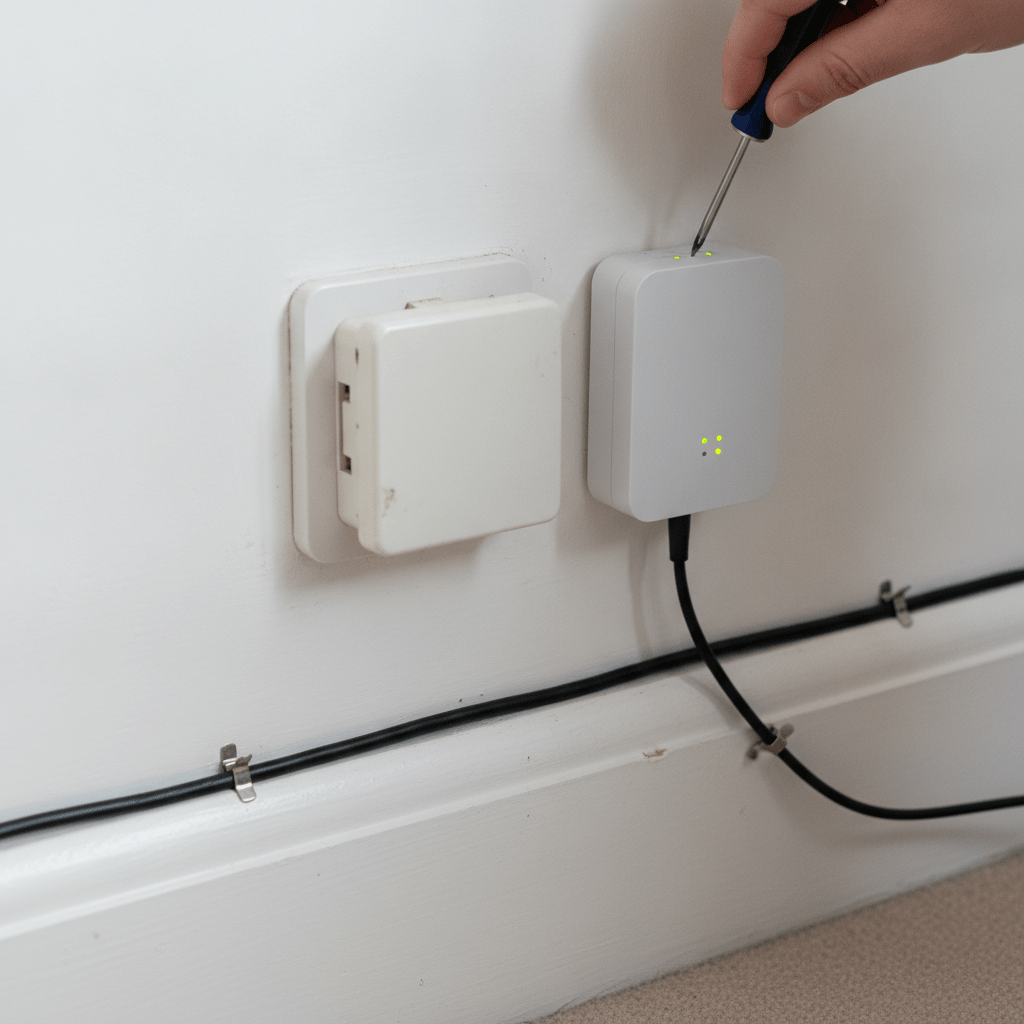
Check for a small white or grey box (an ONT, or optical network terminal) fitted to an outside or inside wall, usually near where your router sits — this only appears on genuine FTTP connections. You can also check your account or bill for “Full Fibre,” “FTTP,” or a provider-specific full fibre plan name, or run a speed test and compare the result against your package’s advertised speed.
What happens to my broadband when the landline switches off in 2027?
The UK’s analogue copper phone network switches off completely on 31 January 2027, and Openreach is already withdrawing copper-based broadband products area-by-area ahead of that date through “stop-sell” orders. If your address is on FTTC when your local exchange area migrates, you’ll need to move to full fibre or another fibre-backed alternative — checking availability now avoids being rushed into a deal later.
Can I get full fibre if I rent my home?
Yes, renters can usually get full fibre installed, but landlord permission is typically needed for the external wall-mounted box an engineer fits during installation. Check your tenancy agreement first, and if you might move before your contract ends, look for providers offering shorter terms or penalty-free relocation.
Check Full Fibre Deals From Every Major UK Network
Now you know which network actually serves your street, compare live full fibre deals from the providers below.
Prices, network availability, and contract terms above are correct as of August 2026 based on our research and each provider’s public pricing, but broadband deals change often — always confirm the current price and availability at your postcode before signing up. Some links on this page are affiliate links, and TheTechVector may earn a commission if you sign up through them, at no extra cost to you.

Written by the TheTechVector Team
We research UK broadband, VPN, laptop, and mobile deals so you don’t have to. All prices are checked before publication — if something’s out of date, let us know.
Full fibre availability expands year-round; if you’re newly eligible, Black Friday deals from full-fibre providers are worth comparing.
This site contains affiliate links to products. We may receive a commission for purchases made through these links.