Affiliate disclosure: TheTechVector earns a commission if you sign up via links on this page, at no extra cost to you. Our recommendations are based on independent research — we are not paid to favour any provider. Learn more about how we make money.
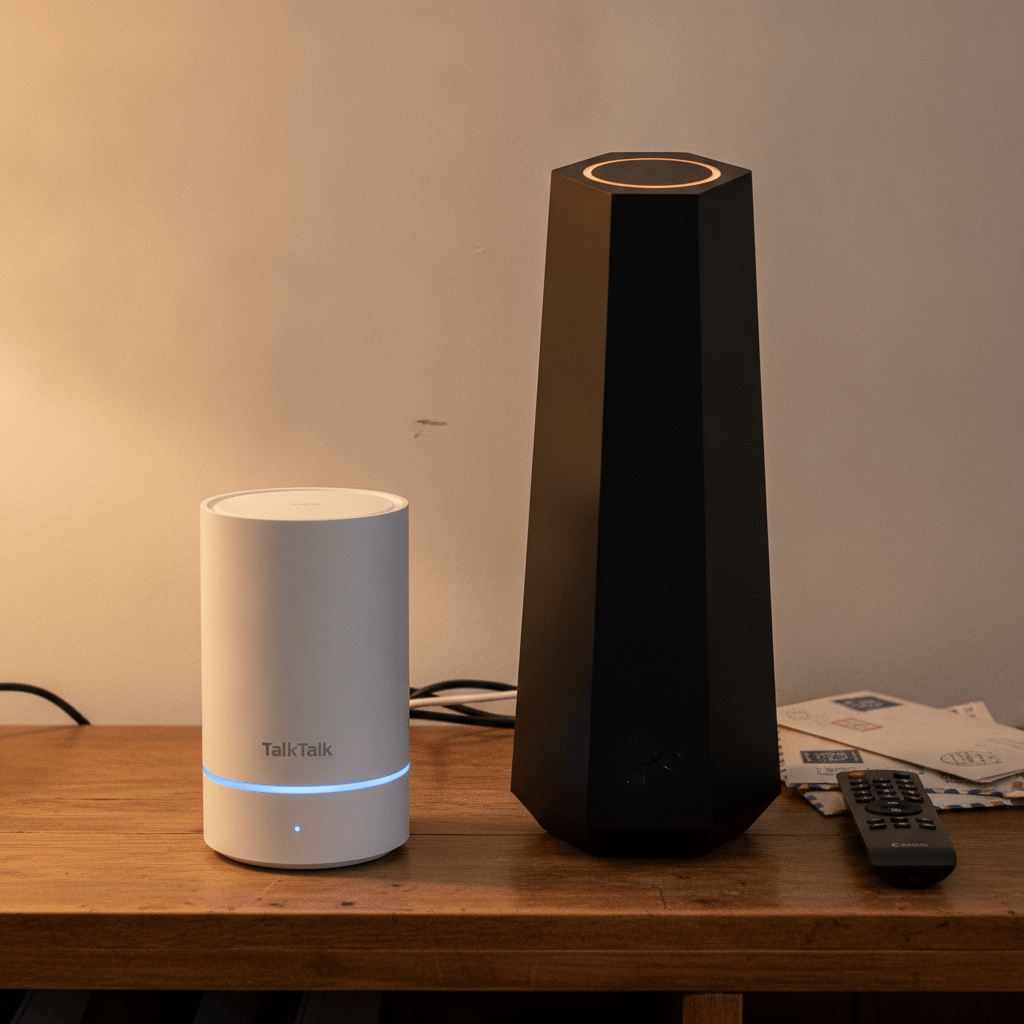
TalkTalk vs Virgin Media broadband comes down to one question before speed or price even enter the picture: can you actually get Virgin Media at your address? TalkTalk rides on Openreach’s and CityFibre’s networks, so it reaches the vast majority of UK homes. Virgin Media runs its own cable network, which only passes roughly half to two-thirds of UK premises. Once you know which one you can get, the choice usually sorts itself out fast — TalkTalk for budget-conscious, near-universal coverage, Virgin Media for the fastest speeds if the cable already runs down your street.
Last updated: August 2026
TalkTalk vs Virgin Media at a glance
Here’s the short version before we get into the detail. TalkTalk wins on availability and starting price; Virgin Media wins on top-end speed and has fewer complaints per customer.
| Provider | Rating | Cheapest plan | Deal |
|---|---|---|---|
| Virgin Media | 8.6/10 | ~£24/mo | View Deal |
| TalkTalk | 8.4/10 | ~£25/mo | View Deal |
| Feature | TalkTalk | Virgin Media |
|---|---|---|
| Network type | FTTC/FTTP over Openreach + CityFibre | Own cable (DOCSIS), upgrading to Nexfibre FTTP in patches |
| UK coverage | Near-universal (Openreach FTTP ~78%, targeting ~85% by Dec 2026, plus CityFibre) | Roughly 50–60% of premises (own-network footprint) |
| Cheapest plan | ~£25/mo (Full Fibre 150, as of August 2026) | ~£24/mo (M125, as of August 2026) |
| Fastest plan | ~£36/mo (Full Fibre 900, as of August 2026) | ~£50/mo (Gig2 Full Fibre, 2,000Mbps, as of August 2026) |
| Contract length | 24 months only | 24 months only |
| Router supplied | Wi-Fi Hub 3 (Fibre 35/65), eero 6 (Full Fibre 150), eero Pro 6 (Full Fibre 500/900) | Hub 5 (Wi-Fi 6, all tiers) |
| Ofcom complaints | 10 per 100,000 customers (Q1 2026) | 6 per 100,000 customers (Q1 2026, industry average) |
| Setup fee | None | None on packages checked |
Quick verdict: who wins each category
Best for availability & price: TalkTalk — 8.4/10
If you’re not sure Virgin Media even reaches your street, or you just want the cheapest reliable full-fibre deal going, TalkTalk is the safer starting point. It’s on Openreach and CityFibre, so it’s available almost everywhere, and its Full Fibre 150 package undercuts Virgin’s equivalent.
Best for speed & fewer complaints: Virgin Media — 8.6/10
If Virgin’s cable already runs to your home and you want serious speed for a houseful of streamers, gamers and smart devices, Virgin Media is hard to beat — up to 2,000Mbps on Gig2, and fewer Ofcom complaints per customer than TalkTalk.
Different networks, different trade-offs: FTTC/FTTP vs cable explained
TalkTalk and Virgin Media don’t run on the same physical infrastructure, and that single fact explains most of the differences between them. TalkTalk sells access to Openreach’s national network — the same copper-and-fibre infrastructure BT, EE, Sky and Plusnet all use — plus a growing footprint on CityFibre’s independent full-fibre network in over 100 towns and cities. Because Openreach reaches nearly every UK address, TalkTalk can offer a product almost anywhere: full-fibre (FTTP) where it’s been built, and part-fibre (FTTC, fibre to the cabinet with a copper run to your home) where it hasn’t yet.
Virgin Media is different — it owns and runs its own cable (DOCSIS) network end to end, separate from Openreach entirely, and is gradually upgrading parts of it to full-fibre Nexfibre. That ownership is why Virgin can push such high headline speeds (up to 2,000Mbps on Gig2), but it also means Virgin’s reach is limited to wherever that cable has physically been laid — third-party trackers put this at roughly 50–60% of UK premises, concentrated in urban and suburban areas. Cable is also a shared local loop, which historically meant slower speeds at peak times on older packages, though Virgin’s DOCSIS 3.1 upgrades have narrowed that gap considerably in recent years.
In practice, this means the real first question isn’t “which is faster” — it’s “can I even get Virgin Media.” Run a postcode check for both before comparing prices; there’s no point picking a winner on paper if only one of them serves your address.
TalkTalk broadband — budget-friendly and almost everywhere
TalkTalk’s Full Fibre 150 runs at ~£25/mo (as of August 2026) on a 24-month contract with no setup fee — genuinely one of the cheapest full-fibre deals on the market right now. Full Fibre 65 sits at ~£26/mo, Full Fibre 500 at ~£30/mo, and the top-tier Full Fibre 900 at ~£36/mo (all as of August 2026, all 24-month contracts). Some postcode checkers still surface a legacy FTTC “Fibre 35” product around ~£26/mo in areas where full fibre hasn’t landed yet — worth checking via TalkTalk’s own postcode tool rather than assuming it’s on offer everywhere.
Every TalkTalk tier is a 24-month contract — there’s no 12-month or rolling option, so you’re committing for two years regardless of which speed you pick. Where TalkTalk pulls ahead of most budget rivals is reach: because it sits on Openreach’s network (currently around 78% FTTP coverage, targeting roughly 85% by December 2026) plus CityFibre in over 100 towns, most UK addresses can get some TalkTalk product even where full fibre hasn’t arrived yet, unlike Virgin Media’s much narrower own-network footprint.
Read our full TalkTalk broadband review for a deeper breakdown of every package. One thing worth flagging here: TalkTalk had the highest Ofcom complaint rate of the major providers in Q1 2026, at 10 per 100,000 customers — mostly faults, service and provisioning, plus billing issues. That’s still well below the industry’s 2011 peak (complaints across the board are down 85% since then), but it’s above the current industry average of 6 per 100,000.
Pros
- Cheapest full-fibre entry price of the two, from ~£25/mo
- Near-universal availability via Openreach + CityFibre
- No setup fee, and free eero mesh hardware on higher tiers
Cons
- Highest Ofcom complaint rate of the majors this quarter (10/100k)
- 24-month contracts only — no shorter option
- Entry-tier areas may still be FTTC (part-copper), not full fibre
Virgin Media broadband — cable speed, if it reaches your street
Virgin Media’s entry-level M125 (132Mbps) runs at ~£24/mo (as of August 2026) on a 24-month contract, undercutting TalkTalk’s cheapest tier slightly on headline price alone — but the packages diverge fast from there. M250 (264Mbps) is ~£26/mo, M350 (362Mbps) ~£29/mo, M500 (516Mbps) ~£28/mo, Gig1 (1,136Mbps) ~£30/mo, and the top-tier Gig2 Full Fibre (2,000Mbps, Nexfibre areas only) ~£50/mo — all 24-month contracts, all as of August 2026. No other mainstream UK provider offers a residential tier that fast.
Upload speeds aren’t listed on Virgin’s own packages page, but they’re worth knowing before you commit: M500 uploads around 52Mbps and Gig1 around 104Mbps. The catch with all of this is availability. Virgin runs its own cable network rather than leasing Openreach’s, and that network only physically reaches roughly 50–60% of UK premises, concentrated in towns and cities. If you’re outside that footprint, none of these prices or speeds are relevant to you — check via Virgin’s own postcode tool before getting attached to a package.
Read our full Virgin Media broadband review for the complete tier-by-tier breakdown. On the plus side, Virgin Media’s Ofcom complaint rate is the industry average at 6 per 100,000 customers (Q1 2026) — clearly better than TalkTalk’s 10, and among the better records of the majors.
Pros
- Fastest residential speeds in the UK — up to 2,000Mbps on Gig2
- Fewer Ofcom complaints than TalkTalk (6 vs 10 per 100,000)
- Hub 5 is a genuinely capable Wi-Fi 6 router as standard
Cons
- Only reaches roughly 50–60% of UK premises — check before you fall in love with the price
- Steep out-of-contract price jumps (M125 to ~£62/mo, Gig1 to ~£86/mo)
- Cable network historically prone to peak-time contention, though narrowing with DOCSIS 3.1
Price rises: what happens to your bill after the first year
Both TalkTalk and Virgin Media now disclose fixed, pounds-and-pence price rises at sign-up rather than the old inflation-linked model, following Ofcom’s industry-wide ban on RPI-linked mid-contract increases. The mechanics differ between the two, though, and knowing them matters more than the headline price.
TalkTalk moved to a flat, pre-disclosed rise from 16 November 2025. New and re-contracting customers see roughly £3–4/month added each April, shown clearly at sign-up — for example, Full Fibre 150 rises from ~£25/mo to ~£29/mo in April 2027, then ~£33/mo in April 2028 (as of August 2026 pricing). Customers who joined between 12 August 2024 and 15 November 2025 are still on a flat £3/month annual rise. Anyone who joined before 12 August 2024 and remains in contract is still on the old CPI+3.7% variable model.
Virgin Media’s rise depends on exactly when you signed up, which is genuinely confusing and worth spelling out plainly. Contracts starting from 9 January 2025 rise by £3.50/month from 1 April each year. Contracts starting from 2 October 2025 rise by £4/month from 1 April each year. Anyone who signed before 9 January 2025 is still on the old RPI+3.9% model — for April 2026 that worked out to a 7.7% increase, since January 2026 RPI ran at 3.8%. Two Virgin Media customers who joined a few months apart can genuinely be on two different rise mechanics, so check your own contract paperwork rather than assuming.
The bigger shock with Virgin Media is what happens once your 24-month contract ends and you don’t re-sign: prices jump to the out-of-contract rate, which can roughly double the monthly cost (M125 to ~£62/mo, Gig1 to ~£86/mo, as of August 2026). Set a calendar reminder for month 22 and either re-sign or switch — don’t let it roll onto the out-of-contract price by accident. If you’re mainly chasing the lowest possible bill, it’s worth comparing against our roundup of cheapest broadband deals right now before you commit to either.
Router hardware: TalkTalk’s Wi-Fi Hub 3 and eero mesh vs Virgin’s Hub 5
TalkTalk doesn’t supply the same router across every tier, which trips people up. On standard and superfast fibre (Fibre 35/65) you get the Wi-Fi Hub 3, a rebadged Sagemcom FAST 5364 with Wi-Fi 5/6-class radios, gigabit Ethernet and a built-in firewall — perfectly fine for a small household, less so for a big house with dead spots. Step up to Full Fibre 150 and TalkTalk swaps this for an Amazon eero 6, a proper mesh-capable unit. Full Fibre 500 and Full Fibre 900 customers get the faster eero Pro 6 instead, which handles higher throughput and more simultaneous devices without buckling. See our full Amazon eero review for how these bundled units compare to eero’s newer standalone models.
Virgin Media keeps it simpler: the Hub 5 ships across the current range regardless of tier. It’s a genuinely solid piece of kit — Wi-Fi 6 (802.11ax) certified, WPA3 security, 4×4 MIMO on the 5GHz band and 3×3 MIMO on 2.4GHz, seven internal antennas, one 2.5Gbps Ethernet port plus three 1Gbps ports, and a casing made from recycled plastic. For most homes it won’t need replacing on day one, which isn’t something you can say about every ISP-supplied router.
If you’re on an older package with either provider, or your home has awkward dead spots regardless of which router you’re supplied, it’s worth reading up on whether you need to upgrade your router before spending money on a mesh system you might not actually need.
Availability, reliability and complaints: which one can you even get
TalkTalk is available to nearly every UK address in some form, because it sells access to Openreach’s near-national network (currently ~78% FTTP coverage, targeting ~85% by December 2026) plus CityFibre’s independent full-fibre network in over 100 towns and cities. Virgin Media, by contrast, only reaches roughly 50–60% of UK premises — its own cable network was never built to cover the whole country, and where it hasn’t been laid, no amount of comparing prices will get you a Virgin Media connection. Always run both postcode checkers before deciding; it’s the single step that avoids the most wasted time in this whole comparison.
On reliability, the clearest independent measure is Ofcom’s complaints data. For Q1 2026 (January–March), TalkTalk logged 10 complaints per 100,000 customers — the highest of the majors this quarter, driven mostly by faults, service and provisioning issues plus billing. Virgin Media logged 6 per 100,000, sitting exactly at the industry average. For context, BT sat at 7, Vodafone at 8, Sky at 5, Plusnet at 4 and EE at 6. It’s also worth noting the bigger trend: Ofcom-reported telecoms complaints across the whole industry are at a record low, down 85% from their 2011 peak, so TalkTalk’s figure is a relative weak spot rather than an alarming one in absolute terms. Some older comparison articles still circulate a stale “13 per 100,000” figure for TalkTalk — that’s outdated; 10 per 100,000 is the current, dated Ofcom figure.

Which is right for you?
Budget-conscious households, or anywhere outside Virgin’s cable footprint
If you’ve checked and Virgin Media simply isn’t available at your address — or it is, but you’d rather not pay the premium — TalkTalk is the sensible default. Full Fibre 150 at ~£25/mo (August 2026) covers most households comfortably, and because it’s built on Openreach and CityFibre, you’re not gambling on a network that might not reach you.
Gigabit-hungry households in a Virgin cable area
If Virgin’s network already runs to your home and you’ve got a household full of 4K streaming, competitive gaming, cloud backups and video calls happening at once, Virgin Media’s Gig1 or Gig2 tiers deliver headline speeds nothing else in this comparison can match — and with a better complaints record than TalkTalk to boot.
Anyone who’s been burned by a surprise price rise before
Read the small print on both before you sign. TalkTalk’s rise mechanics are more consistent across recent customers; Virgin Media’s depend heavily on your exact sign-up date, and the out-of-contract jump if you forget to re-sign is genuinely steep on both providers, but especially Virgin. Either way, note the date your contract ends and act before it lapses.
How to compare and switch
Switching between broadband providers in the UK is more straightforward than it used to be, thanks to Ofcom’s one-touch switching rules. Here’s the short version:
- Run a postcode check with both TalkTalk and Virgin Media to confirm what’s actually available at your address.
- Compare the real monthly cost over 24 months for matched speed tiers, including the scheduled April price rises, not just the headline first-year price.
- Check your current contract’s end date and any exit fees if you’re switching early.
- Sign up with the new provider — if you’re switching between two mainstream providers, they’ll usually coordinate the switch and cancel your old service for you.
- Keep your old router until the new service is confirmed live, in case you need to fall back on it.
For the full step-by-step process, including what to do if your provider tries to talk you out of leaving, see how to switch broadband. And if neither TalkTalk nor Virgin Media turns out to be available or right for you, it’s worth taking a wider look at compare all UK broadband providers before settling.
Frequently asked questions
Is TalkTalk or Virgin Media better for broadband?
TalkTalk is generally better for availability and price, since it’s built on Openreach and CityFibre and reaches nearly every UK address, with Full Fibre 150 from ~£25/mo (August 2026). Virgin Media is better for raw speed and has a lower Ofcom complaint rate, but its own cable network only reaches roughly 50–60% of UK premises, so it isn’t an option everywhere.
Is TalkTalk cheaper than Virgin Media?
TalkTalk’s entry-level full-fibre tier is close to Virgin Media’s cheapest package, but TalkTalk tends to work out cheaper overall once you factor in Virgin’s steeper price rises and out-of-contract jump. TalkTalk Full Fibre 150 runs ~£25/mo versus Virgin Media M125 at ~£24/mo (both August 2026), but Virgin’s out-of-contract price for M125 can rise to ~£62/mo if you don’t re-sign, a steeper jump than TalkTalk’s equivalent.
Can I get Virgin Media broadband at my address?
Virgin Media broadband is only available where its own cable network has physically been laid, which covers roughly 50–60% of UK premises, mostly in urban and suburban areas. Run a postcode check on Virgin Media’s own site before comparing packages — there’s no point picking speeds and prices for a service you can’t actually order.
What router do TalkTalk and Virgin Media supply?
TalkTalk supplies different routers depending on your package: the Wi-Fi Hub 3 on standard and superfast fibre (Fibre 35/65), an Amazon eero 6 on Full Fibre 150, and an Amazon eero Pro 6 on Full Fibre 500 and 900. Virgin Media supplies the Hub 5 across its entire current range, a Wi-Fi 6 router with 4×4 MIMO and a 2.5Gbps Ethernet port.
How much will my bill go up after the first year?
Both providers now apply a fixed, pre-disclosed rise each April rather than an inflation-linked one. TalkTalk customers who signed up from 16 November 2025 see roughly £3–4/month added each April. Virgin Media’s rise depends on your exact sign-up date — £3.50/month for contracts from 9 January 2025, or £4/month for contracts from 2 October 2025. Older contracts on both providers may still be on legacy variable-rate models, so check your own paperwork.
Which has fewer complaints, TalkTalk or Virgin Media?
Virgin Media has fewer Ofcom complaints, at 6 per 100,000 customers for Q1 2026, exactly at the industry average. TalkTalk logged 10 per 100,000 in the same period, the highest among the major providers, mostly relating to faults, service and provisioning, plus billing issues.
Does Virgin Media broadband have a data cap?
Virgin Media’s standard residential broadband packages are unlimited with no data cap. This is standard practice across all the major UK providers covered in this comparison, including TalkTalk, so data limits shouldn’t be a deciding factor between the two.
Can I get TalkTalk full fibre where I live?
TalkTalk full fibre is available to a large and growing majority of UK addresses, since it uses Openreach’s FTTP network (currently around 78% coverage, targeting roughly 85% by December 2026) plus CityFibre’s independent network in over 100 towns and cities. If full fibre hasn’t reached your address yet, TalkTalk can usually still offer a part-fibre (FTTC) product instead — check via TalkTalk’s postcode tool for your exact options.
Ready to compare deals?
Check current availability and pricing for both providers at your address before you decide.
Prices, contract terms and network coverage change often, so always confirm the current figures directly with the provider before signing up. We update this comparison regularly, but TheTechVector earns a commission if you sign up via the links above — it doesn’t affect which provider we recommend, and our verdicts are based on independent research, not payment.

Written by the TheTechVector Team
We research UK broadband, VPN, laptop, and mobile deals so you don’t have to. All prices are checked before publication — if something’s out of date, let us know.
This site contains affiliate links to products. We may receive a commission for purchases made through these links.